Friday, March 29, 2013

100 editions of the Tour d France, 1910


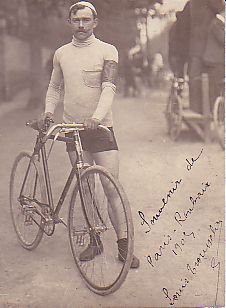
1910 Alcyon ridden by Octave Lapize FRA
This was the year the big mountains were introduced and the organisers didn't mess around with the choice of summits, creating a course where the riders tackled the Peyresourde, Tourmalet, Aspin and Aubisque. 

Unrelated to the mountains, it was also the year of the first TdF death, with Adolphe Heliere drowning in the med during a rest day dip!

The decision to include the high mountains was famously proceeded by Desgrange sending one of his staff to check out the route, 2 months before the event. Although in trying to cross the Tourmalet Desgrange employee Steinès become stuck in a snow drift before becoming lost in the snow after abandoning his car on the mountain side. Eventually he was rescued in the early hours by locals who found him trapped in a ravine after falling from an icy ledge. 
His famous telegram to the boss read, 
" No trouble crossing the Tourmalet. Roads satisfactory. No problem for cyclists. Stienés".

This wasn't the only famous quote from the 1910 Tour. On the 'Queen' stage the riders tackled four big mountains, concluding with the Aubisque, where Lapize was found by the organisers pushing his bike in second place, 15mins behind the lone and unknown leader. Lapize, through in a haze of fatique, uttered the words "Vous être des assassins!" and promised to quit at the next village.
But he didn't quit, he continued and sealed the win that would see him beat team mate, favorite and close rival Faber to his only Tour victory. Indeed he was never to even finish the Tour agin despite trying 4 more times though he did win many other prestigious events. 
Like many riders of this time he died during the war when his fighter plane was shot down near Verdun. He was 29.

Lapize on the Tourmalet

100 editions of the Tour de France, 1909


1909 Alcyon ridden by Français Faber LUX
If the 1908 race was all about Peugeot then the 1909 edition was all about Alcyon and more specifically, Français Faber.

Faber was a big man, 1.86m and 91kg apparently and he clearly had the heart of a lion. As a Luxembourger he was also the first 'foreigner' to win the Tour.

Some say that the 1909 Tour had the worst weather ever but it didn't stop Faber winning 5 stages in a row, which has yet to be equalled. 
Stage 2 was run off in freezing rain for the entire 398k and Faber rode the second half on his own to finish over 30 mins ahead of the second place man, a feat he replicated on stage 3. Since the points system was still in play he gained no more than if he'd won a sprint by half a wheel.
As you can see in the photograph he won stage 4 on foot after to braking his chain as he entered Lyon.
Stage 5 was equally eventful, due to tremendous winds which knocked him from his bike twice and then a horse joined the act, also knocking him to the ground. 

In the end Alcyon took the first 5 places but it should be noted that from 1909 to 1911 Peugeot, for a reason I have yet to find, boycotted the race so many of it's star riders switched to Alcyon.

A sad footnote, but one that sums up Faber, is that he was killed in 1915 as he carried a wounded comrade through no mans land as he fought in the First World War. 


FRANCOIS-FABER.jpg

100 editions of the Tour de France 1908


1908 Peugeot ridden by Lucien Petit-Breton FRA
The 1908 race can only be seen as one thing, a tribute to the Peugeot team. To this day the most successful team ever and winners of more Tours than any other team.

This year, not only did they win overall with Petit-Breton but they also took the first 4 places (and 6th and 8th) and won EVERY stage.
It's hardly surprising when the team included, alongside Petit-Breton, who had won the previous year, Français Faber who would win the following year and go on to take the Paris-Roubaix, Henri Cornet the 1904 winner, Georges Passerieu who had a 2nd in the Tour to his name and was also a Paris-Roubaix winner, Hippolyte Aucouturier, another Tour runner up and double Paris-Roubaix victor and Gustave Garrigou, second again in 1908 and winner in 1911. Even the lesser know team members were, or would go on to be, stage winners.

Petit-Breton himself was considered the perfect bike racer. He had great endurance, yet he had a formidable sprint which was useful at a time when the Tour was decided on points, meaning that losing minutes in the mountains was no more of a penalty than missing out in the sprint by a bikes length. This was important when you realise that when they crossed the Ballon d'Alsace, which is by no means the hardest climb in France, only one rider managed it without getting off and pushing.
His other great strength was that as a bicycle mechanic, which also shouldn't be underestimated in the days when riders had to do all their own repairs, without outside assistance.


100 editions of the Tour de France 1907


1907 Peugeot ridden by Lucien Petit-Breton FRA
Despite being hit by a double dose of bad fortune, Peugeot wins their third straight Tour. The previous years winners, Rene Pottier tragically commits suicide and is remembered with a memorial atop the Ballon d'Alsace, while Peugeots strongest rider and Tour leader, Emile Garrigou, is docked points for an illegal bike change. Fortunately for the team they have strength in numbers, finishing with the first 5 riders overall, though their success is exaggerated by the fact that powerful rivals, Alcyon withdraw after Garrigou is not thrown off the race.

Petit-Breton

Although well installed as a sporting monument by 1907, the Tour wasn't immune from a few crazy antics, non more so than adventures of Henri Pépin. His preferred title of Baron Henri Pépin de Gontaud was probably invented, though he was clearly monied since he could afford to pay two pro riders to sacrifice their chances in order to chaperone him around the course. But Pépin wasn't out to upset the leaderboard, he was there for the craic as we might say today. Despite being part of the worlds biggest cycle race it didn't prevent him from stopping for long lunches and finishing up to 12 hours behind the winner on some stages. In the end he only managed to complete 5 stages but he still paid his helpers more than the winner earned. I think he may have been integral in the decision to introduce cut off times for the slower riders!


  1907 Peugeot Tour de France bike.

100 editions of the Tour de France, 1906


1906 Peugeot ridden by Renè Pottier FRA
At 4545k the 1906 Tour was over 50% longer than the previous years event and a thousand kilometers longer than in 2012. Although the average speed suffered so did the riders with only 14 of the 76 starters making it to Paris.
After abandoning the 1905 Tour while leading the race, Pottier was easily the strongest rider in the 1906 edition, as he showed by attacking on the 3rd stage and staying away for 200k, to finish over 47mins ahead of the next rider.

This was the first Tour where freewheels were used with success, enabling riders to coast down the bigger descents, rather than pedaling like fury or even taking their feet off the pedals completely. It wasn't unheard of for riders to have footpegs on the forks in order to rest their feet.

With only one gear the riders obviously had to prioritize the ascents so gears were on the small side, though bigger than the smallest gears today. 44x22 was typical, or the equivalent to 22x11 since they were using 1" pitch chains. This must have lead to some incredible pedaling speeds on the faster sections. It wasn't until the 1910 to 1913 period that double sided rear wheels become commonplace.

The 1903 and 1905 winners both had toeclips, but no straps, which didn't appear until around 1907, with Petit-Breton definitely using them in 1908.

Sunday, March 24, 2013

100 editions of the Tour de France, 1905


1905 Peugeot ridden by Louis Trousselier FRA
After the antics of 1904, the 1905 race was different in many ways, though there are still stories of tacks being thrown on the road, with less blatant cheating.
Firstly there were more stages, 11 in all, and they were shorter so that riding through the night was minimised. The winner was decided by a simple points system so that distancing a rival by hours had less effect on the final standings. 
The riders didn't have it all there own way. To make up for the 'easier' stages the Tour was much longer than the two previous additions, at around 3000k and there were real mountains for the first time, including the Ballon d'Alsace (1,178m), a favourite of todays sportive riders. Non of these seem to deter the riders, who sped round the route nearly 2kph faster than in 1905, at over 27kph. With their fixed gears bikes and typical 22x11 gearing, 27.2kph equates to an average cadence of 105 rpm. That's average!

Although still riding single fixed gear bikes, the organisers generously allowed bike changes to machines with higher or lower gears depending on the terrain. In fact there were two categories of riders, the coureurs de vitesse and the coureurs sur machines poinçonnées.The riders in the first category were allowed to change bicycles, while the riders in the machines poinçonnées category had to use the same bicycle for the entire race,

Pautrat who finished 8th overall was the winner of the coureurs sur machines poinçonnées category.


Amazingly Trousselier won 6950 francs as victor, which was a huge sum even in todays money, yet blew the lot of it after a night of drinking and gambling with friends the night the race finished. I've heard that Lance had some good bashes but Trousselier clearly knew how to party. Luckily he came from a wealthy family that had a flower business in the centre of Paris, which he took over after WW1. In fact race organiser, Henri Desgrange, always seeking to give his riders more colourful personalities with descriptive nicknames referred to Trousselier as "the florist". Well, it's better than Trou-Trou, his other name given by the fans that fellows the normal, rather uninspired, French way of creating these nick names. 

Trousselier was obviously a bit of a lad and actually rode the Tour while on a few days leave from the army. Apparently only the fact that he won saved him from possible punishment for desertion.

1905 was the first year that Peugeot won the Tour and was their first step in becoming not only the most successful Tour de France team, but also the most successful cycling team of all time.


Saturday, March 23, 2013

100 editions of the Tour de France, 1904


1904 Cycles J.C. ridden by Henri Cornet FRA
Maurice Garin defended his title in 1904 only to be later disqualified and, cynics might say, starts a trend of cheating that lasts to this day. When Garin was handed a  two year ban he decided to call it quits and retired from the sport.

Garin was far from alone in committing misdemeanors since there was general mayhem in the 1904 race. Stories of cheating were rife, from taking tows from cars and motorcycles to attempted poisoning. The fans were worse, felling trees to block the roads, spreading tacks and beating riders to a pulp at the roadside. An arguement by rival betting cartels ended in a mass brawl that was only ended by pistol shots being fired by Lefèvre, creator of the Tour.

The format of the race was the same as the previous years, 6 stages, averaging over 400k each, with night time starts to ensure afternoon finishes. It was impossible to police the 88 riders over such distances, but rumours started to circulate that Lefèvre had illegally fed Garin from the official car, worried about the Tour's big star dropping out with hunger knock.

The news lead to other riders taking matters into the own hands, by taking pace from cars and motorcycles, while mobs at the side of the road tried to obstruct or even beat up riders in order to help the local stars. There was a plan to attack and even knife Garin and in fact Giovanni Gerbi who was riding with Garin retired suffering broken fingers following an attack on the pair as they traversed the col de la Républic. 

Eventually the first four riders were disqualified leading to the crowning of Henri Cornet, who at 19 is to this day the youngest ever winner.

Garin's bike, from Cycles JC was created by J.Conte who was another manufacturer that started in the late 1890s. Like Peugeot they were based on the avenue de la Grande Armée in Paris. I believed that they were later swallowed by their mighty neighbors.

1904 Tour de france route map
It wasn't until much later that transfer stages were added, so these early Tours really did circulate the country