Friday, March 29, 2013

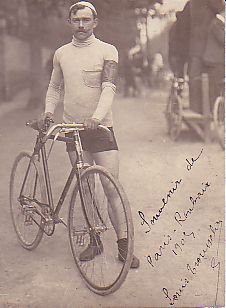
100 editions of the Tour de France 1907


1907 Peugeot ridden by Lucien Petit-Breton FRA
Despite being hit by a double dose of bad fortune, Peugeot wins their third straight Tour. The previous years winners, Rene Pottier tragically commits suicide and is remembered with a memorial atop the Ballon d'Alsace, while Peugeots strongest rider and Tour leader, Emile Garrigou, is docked points for an illegal bike change. Fortunately for the team they have strength in numbers, finishing with the first 5 riders overall, though their success is exaggerated by the fact that powerful rivals, Alcyon withdraw after Garrigou is not thrown off the race.

Petit-Breton

Although well installed as a sporting monument by 1907, the Tour wasn't immune from a few crazy antics, non more so than adventures of Henri Pépin. His preferred title of Baron Henri Pépin de Gontaud was probably invented, though he was clearly monied since he could afford to pay two pro riders to sacrifice their chances in order to chaperone him around the course. But Pépin wasn't out to upset the leaderboard, he was there for the craic as we might say today. Despite being part of the worlds biggest cycle race it didn't prevent him from stopping for long lunches and finishing up to 12 hours behind the winner on some stages. In the end he only managed to complete 5 stages but he still paid his helpers more than the winner earned. I think he may have been integral in the decision to introduce cut off times for the slower riders!


  1907 Peugeot Tour de France bike.

100 editions of the Tour de France, 1906


1906 Peugeot ridden by Renè Pottier FRA
At 4545k the 1906 Tour was over 50% longer than the previous years event and a thousand kilometers longer than in 2012. Although the average speed suffered so did the riders with only 14 of the 76 starters making it to Paris.
After abandoning the 1905 Tour while leading the race, Pottier was easily the strongest rider in the 1906 edition, as he showed by attacking on the 3rd stage and staying away for 200k, to finish over 47mins ahead of the next rider.

This was the first Tour where freewheels were used with success, enabling riders to coast down the bigger descents, rather than pedaling like fury or even taking their feet off the pedals completely. It wasn't unheard of for riders to have footpegs on the forks in order to rest their feet.

With only one gear the riders obviously had to prioritize the ascents so gears were on the small side, though bigger than the smallest gears today. 44x22 was typical, or the equivalent to 22x11 since they were using 1" pitch chains. This must have lead to some incredible pedaling speeds on the faster sections. It wasn't until the 1910 to 1913 period that double sided rear wheels become commonplace.

The 1903 and 1905 winners both had toeclips, but no straps, which didn't appear until around 1907, with Petit-Breton definitely using them in 1908.

Sunday, March 24, 2013

100 editions of the Tour de France, 1905


1905 Peugeot ridden by Louis Trousselier FRA
After the antics of 1904, the 1905 race was different in many ways, though there are still stories of tacks being thrown on the road, with less blatant cheating.
Firstly there were more stages, 11 in all, and they were shorter so that riding through the night was minimised. The winner was decided by a simple points system so that distancing a rival by hours had less effect on the final standings. 
The riders didn't have it all there own way. To make up for the 'easier' stages the Tour was much longer than the two previous additions, at around 3000k and there were real mountains for the first time, including the Ballon d'Alsace (1,178m), a favourite of todays sportive riders. Non of these seem to deter the riders, who sped round the route nearly 2kph faster than in 1905, at over 27kph. With their fixed gears bikes and typical 22x11 gearing, 27.2kph equates to an average cadence of 105 rpm. That's average!

Although still riding single fixed gear bikes, the organisers generously allowed bike changes to machines with higher or lower gears depending on the terrain. In fact there were two categories of riders, the coureurs de vitesse and the coureurs sur machines poinçonnées.The riders in the first category were allowed to change bicycles, while the riders in the machines poinçonnées category had to use the same bicycle for the entire race,

Pautrat who finished 8th overall was the winner of the coureurs sur machines poinçonnées category.


Amazingly Trousselier won 6950 francs as victor, which was a huge sum even in todays money, yet blew the lot of it after a night of drinking and gambling with friends the night the race finished. I've heard that Lance had some good bashes but Trousselier clearly knew how to party. Luckily he came from a wealthy family that had a flower business in the centre of Paris, which he took over after WW1. In fact race organiser, Henri Desgrange, always seeking to give his riders more colourful personalities with descriptive nicknames referred to Trousselier as "the florist". Well, it's better than Trou-Trou, his other name given by the fans that fellows the normal, rather uninspired, French way of creating these nick names. 

Trousselier was obviously a bit of a lad and actually rode the Tour while on a few days leave from the army. Apparently only the fact that he won saved him from possible punishment for desertion.

1905 was the first year that Peugeot won the Tour and was their first step in becoming not only the most successful Tour de France team, but also the most successful cycling team of all time.


Saturday, March 23, 2013

100 editions of the Tour de France, 1904


1904 Cycles J.C. ridden by Henri Cornet FRA
Maurice Garin defended his title in 1904 only to be later disqualified and, cynics might say, starts a trend of cheating that lasts to this day. When Garin was handed a  two year ban he decided to call it quits and retired from the sport.

Garin was far from alone in committing misdemeanors since there was general mayhem in the 1904 race. Stories of cheating were rife, from taking tows from cars and motorcycles to attempted poisoning. The fans were worse, felling trees to block the roads, spreading tacks and beating riders to a pulp at the roadside. An arguement by rival betting cartels ended in a mass brawl that was only ended by pistol shots being fired by Lefèvre, creator of the Tour.

The format of the race was the same as the previous years, 6 stages, averaging over 400k each, with night time starts to ensure afternoon finishes. It was impossible to police the 88 riders over such distances, but rumours started to circulate that Lefèvre had illegally fed Garin from the official car, worried about the Tour's big star dropping out with hunger knock.

The news lead to other riders taking matters into the own hands, by taking pace from cars and motorcycles, while mobs at the side of the road tried to obstruct or even beat up riders in order to help the local stars. There was a plan to attack and even knife Garin and in fact Giovanni Gerbi who was riding with Garin retired suffering broken fingers following an attack on the pair as they traversed the col de la Républic. 

Eventually the first four riders were disqualified leading to the crowning of Henri Cornet, who at 19 is to this day the youngest ever winner.

Garin's bike, from Cycles JC was created by J.Conte who was another manufacturer that started in the late 1890s. Like Peugeot they were based on the avenue de la Grande Armée in Paris. I believed that they were later swallowed by their mighty neighbors.

1904 Tour de france route map
It wasn't until much later that transfer stages were added, so these early Tours really did circulate the country


Friday, March 22, 2013

100 editions of the Tour de France, 1903


1903 La Française ridden by Maurice-Francois Garin FRA
For roughly the cost of entering this years Etape du Tour you could have ridden the first ever Tour de France. At 2428 kilometers it may have been the second shortest Tour, but it was covered in just 6 stages, and of course the roads were virtually cart tracks. Nevertheless 79 riders paid their 10 francs entry fee, though 19 of those thought better of it before even turning up, and despite the fact that they were allowed to continue in the race even if they had failed to finish the previous stage, only 21 reached the finish at the Parc des Princes in Paris.

The first stage, won by Garin, was a 467k haul from the Au Reveil Matin café in Montgeron, south of Paris through the heart of the country to Lyon. The final stage from Nantes to Paris, also won by Garin, was longer still at 471k.
At the end of the race Garin was 2hours 49 minutes ahead of the second place rider while the last placed man was 64h47m down.

Garin received 3000 francs for winning the race which he used to invest in a garage where he was to work for the rest of his career following his retirement after the 1904 Tour.

Although insanely arduous, even by todays standards, the riders would have tackled a five-week race if l'Auto editor Henri Desgrange had had his way. With only 15 entries he was forced into a last minute rethink. Not only did Desgrange cut the length of the race but he also offered a 5 francs daily allowance.

Winner Garin was already a prolific winner having won his first race 10 years earlier when he took the honours in the Namur-Dinant-Giet in Belgium. He used his 850 francs winnings from that event to purchase a lighter bike, though at 16 kg it was still a hefty machine, despite costing well over €3000 in todays money. At least the pneumatic tyres softened the ride.

For anyone who still has doubts about the exploits of the riders at the turn of the century compared to today, it should be noted the Garin rode a paced 24 hour race and covered over 700k and completed the Paris Brest Paris in 52 hours. 

All the 21 sponsored riders in the race were supported by bicycle manufacturers. The first 5 overall rode for La Française, while the other marques represented were Brennabor, Gladiator, Champeyrache, JC cycles and Diamant.


Société La Française,manufactures of bicycles and spare parts was created by Pierre-Victor Besse and François Trepier in 1891 and was based at 27, rue Saint-Ferdinand à Paris.
In 1894 Mr Trepier sold his shares to John Varmm Hammond to create the brand Besse & Hammond while transferring the head office to 11, rue Brunel, also in Paris. The company had a worth of 500,000 F
In 1899, in search of capital, Alfred Edwards was brought on board, and his stake raised the companies value to 1.6 million francs. Company became La Française-Diamant, manufacturer de Vélocipèdes and Motocycles.

The companies store was run by former world champion track cyclist Edmond Jacquelin from 29, avenue de la Grande Armée (virtually next door to Peugeot) and later opened a branch for export at 34, rue d'Hauteville, again in Paris. The factory was in the suburb of Pantin, at 47 rue Cartier Bresson, a commune in the north eastern of Paris

At the end of WW1, the company joined a consortium of bicycle manufacturers called La Sportive, which included Peugeot, Hurtu, Alcyon, Automoto, Grioffon, Liberator, Laboir, Gladiator, Clement, Armor and Thomann. By 1923, Gentil Alcyon had become the dominant company, and took over La Francaise Diamant, though the marque continued the name would be seen seen in races up until 1955 and was present at the Brussels exhibition of 1956.

Garin first piloted a La Française in 1901 when he won the marathon Paris-Brest-Paris, on board a 18 kg fixed gear machine with a single bowden cable operated brake. The following year he won the Bordeaux-Paris before heading their 8 man Tour de France team.

The bike was typical of that era and although I've read that it was black with a tricolour headtube I've never seen a picture of that colour scheme. The wheelbase was around 1.2m as apposed to the 1m of today, which, as well as the very slack fork rake helped to take some of the sting out of the terrible road surfaces.

It was, of course fixed gear and I believe that it had a single rear brake, which interestingly seemed to be operated by the right hand lever, British style, on all bikes at the time. The only rider who used a free wheel, despite them being available since 1989, was Arsène Millocheau, who finished last.
The fixed gear helped to slow the bikes down, which was quite a useful feature given the primitive nature of the brakes. I noted that Garin had brakes operated by a Bowden because many still had rod brakes, with pads that rubbed on top of the tyre. 


Wednesday, February 20, 2013

Pibal bike, by Starck

The Pibal was launched to much excitement today in Bordeaux. The involvement of the legendary Philippe Starck has given a huge boast to the project as can been seen by the press coverage.  Peugeot are happy to be involved and my colleague explains why;

Sandrine Bouvier of Peugeot says "We are delighted to be associated with the project initiated by the city of Bordeaux to multiply modes of urban transport. Continuous innovation in mobility is a major challenge for the brand since the launch of Mu by Peugeot in September 2009. Successfully mass produce the vision of Starck Bordeaux is the criteria for us exciting." 

I think bikeradars piece on the bike sums it up nicely;

Bordeaux’s answer to London’s Boris Bike and Paris’ Vélib has been unveiled – the ever-so-striking Pibal, designed by Philippe Starck. The pre-prototype shown off to the city mayor yesterday morning is constructed of aluminium and weighs 16kg, 7kg less than its UK cousin.
The bike’s most notable feature is a scooter-inspired platform, for trips where it’s easier to push off and coast. The Pibal features internal hub gearing and dynamo-driven lights. It will be manufactured by Peugeot. 
The first 300 bikes will hit Bordeaux’s boulevards in September 2013 and phase out the city’s current fleet of 3,500 communal bikes, regional paper Sud Ouest reported.
Starck, who is most famous for interior decorating and his cult product and watch designs, worked on the project for free. “I wasn’t interested in the aesthetic at all,” he said. “It's a workhorse; this is a rustic bike.”

It's an intelligent solution to s specific question. Bordeaux is quite a flat city with lots of pedestrianised areas, so  it's logical to create a bike with which you can switch easily between riding, coasting and walking. A pibal is a type of eel and I guess the bike can weave its way through obstacles as easily as an eel. 


Saturday, February 9, 2013

Inspiring bicycle design around the world...

I saw this on the ever brilliant Bicycle Design site. I can't find out who Trixon are, but there's a little bit more information here.....Trixon. 
The bike is en entry for the ISUDA bike share competition. You can still go to Bicycle Design and check out the other entries, vote or just have a browse round James's excellent site.
Of course I've posted this because it's a similar concept to the Peugeot DL122 and eDL122 that I created for Peugeot Design Lab. Hopefully there'll be a surge of interest in intelligent city bike design, which work for all commuters, not just hardened 'cyclists'.